

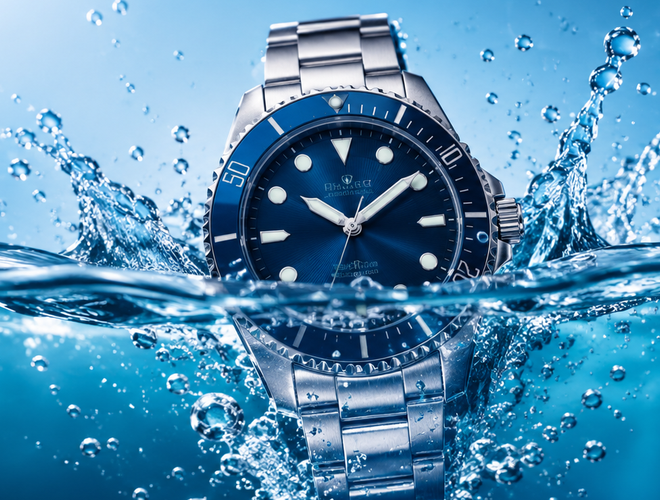

When buying a watch, one of the specifications you will often notice is its water resistance rating. Labels such as 30M, 100M and 200M appear on everything from everyday dress watches to professional diving watches. However, these numbers do not always mean what buyers expect. A watch marked 30M, for example, is not necessarily suitable for swimming at a depth of 30 metres.
Understanding watch water resistance is important because it helps you choose a timepiece that suits your daily activities, whether you wear it to work, exercise regularly or enjoy swimming and water sports.
Water resistance depends on several factors, including the watch’s case construction, seals, crown design and testing standards. Before choosing your next watch, it is worth understanding what these ratings actually represent and how much protection they offer.
1. What Does Watch Water Resistance Actually Mean?
Watch water resistance describes how well a watch can prevent water from entering its internal components under specified testing conditions.
Manufacturers generally display the rating in metres (M), atmospheres (ATM) or bar. These measurements indicate pressure resistance rather than a guaranteed swimming depth.
For example:
- 30M usually corresponds to 3 ATM or 3 bar.
- 50M usually corresponds to 5 ATM or 5 bar.
- 100M usually corresponds to 10 ATM or 10 bar.
- 200M usually corresponds to 20 ATM or 20 bar.
These figures are based on controlled laboratory testing. Real-world activities involve movement, changing pressure and temperature variations, which can create different conditions from a static test.
This is why a watch rated for 30M should not be treated as suitable for swimming at a depth of 30 metres.
2. What Does 30M Water Resistance Mean?
A watch with a 30M water resistance rating is generally designed to handle minor contact with water rather than regular water-based activities.
It may be suitable for everyday situations such as:
- Accidental splashes.
- Light exposure to rain.
- Minor contact with water during daily activities.
However, it is generally not recommended for swimming, showering or water sports.
Many traditional dress watches carry this rating because they are primarily designed for formal and everyday wear rather than aquatic activities.
If you want a watch for regular swimming or outdoor adventures, consider a higher water resistance rating.
3. What Does 100M Water Resistance Mean?
A watch with a 100M rating (10 ATM or 10 bar) offers considerably more water protection than a 30M model. It is generally suitable for regular swimming and snorkelling, provided the manufacturer permits these activities.
This rating is a practical option for people who enjoy water-based activities but do not necessarily need a professional diving watch.
A 100M watch is generally suitable for:
- Swimming in pools.
- Swimming in open water.
- Snorkelling, where permitted by the manufacturer.
- Everyday exposure to rain and water.
However, a standard 100M water-resistant watch should not automatically be considered suitable for scuba diving. For underwater activities involving diving equipment, look for a watch specifically designed and approved for diving.
4. What Does 200M Water Resistance Mean?
A 200M rating (20 ATM or 20 bar) indicates a higher level of water resistance. Watches with this specification are commonly designed for more demanding water activities.
Depending on the manufacturer’s specifications, a suitable 200M watch may be used for:
- Regular swimming.
- Snorkelling.
- Water sports.
- Recreational scuba diving, when specifically approved for it.
However, there is an important distinction between a watch that simply carries a 200M rating and one officially classified as a diver’s watch.
A watch certified to the ISO 6425 diving-watch standard must meet additional requirements relating to water resistance, visibility, durability and diving-time measurement. The standard applies to diver’s watches designed for depths of at least 100 metres.
Horology — Divers’ watches+1
Therefore, if you regularly go scuba diving, look for the appropriate diver’s certification rather than relying on the 200M marking alone.
5. Watch Water Resistance Ratings Compared
The following table provides a general guide to common water resistance ratings. Actual permitted activities can vary between manufacturers and individual models.
| Water Resistance | Equivalent Rating | Typical Use |
| 30M | 3 ATM / 3 bar | Rain and accidental splashes |
| 50M | 5 ATM / 5 bar | Everyday water exposure; some models permit swimming |
| 100M | 10 ATM / 10 bar | Swimming and snorkelling |
| 200M | 20 ATM / 20 bar | Water sports and approved recreational diving |
Always follow the specific manufacturer’s instructions. These ratings are not guaranteed swimming or diving depth limits.
The distinction between everyday water resistance and diving protection is also explained by the Tissot water resistance guidance and the Federation of the Swiss Watch Industry.
6. What Makes a Watch Water Resistant?
Water resistance is not determined by the rating alone. Several components work together to prevent moisture from entering the watch.
Gaskets and seals: These rubber or synthetic components sit around the caseback, crown, crystal and pushers. They help prevent water from entering through small gaps.
Screw-down crown: Some watches feature a crown that screws securely into the case. This helps improve protection against water penetration.
Case construction: A properly sealed case and securely fitted crystal help maintain the watch’s water resistance.
Screw-down caseback: This construction helps create a secure seal between the case and its back.
The quality and condition of these components directly affect how well a watch handles water exposure.
7. How to Maintain Your Watch’s Water Resistance
Even a watch with a high water resistance rating needs proper care. Its protective seals can deteriorate over time due to ageing, temperature changes and regular use.
Follow these precautions to maintain its condition:
- Ensure the crown is fully pushed in or screwed down before water exposure.
- Never operate the crown or buttons underwater unless the manufacturer explicitly permits it.
- Rinse the watch with fresh water after exposure to seawater or chlorinated pool water, where the manufacturer recommends it.
- Avoid exposing the watch to hot showers, saunas and sudden temperature changes.
- Have the seals inspected and water resistance tested periodically, especially after battery replacement or servicing.
Water resistance is not necessarily permanent. Manufacturers such as Casio highlight that seals can deteriorate over time, affecting the watch’s protection.
8. Which Water Resistance Rating Should You Choose?
The right rating depends on how you intend to use your watch.
- For everyday wear: A 30M watch may be sufficient if you mainly need protection against occasional splashes and rain.
- For occasional swimming: Consider a 50M or 100M model, but check the manufacturer’s permitted activities.
- For regular swimming and water sports: A 100M or 200M watch offers a more suitable starting point.
- For scuba diving: Choose a properly specified diver’s watch, preferably one certified to ISO 6425.
If you are purchasing a watch primarily for its appearance, a higher water resistance rating may not be essential. However, if you enjoy outdoor activities and swimming, choosing a more capable model provides greater flexibility.
Final Thoughts
Understanding watch water resistance helps you make a better decision when purchasing a timepiece. While 30M, 100M and 200M ratings may appear to represent actual diving depths, they indicate pressure resistance under controlled testing conditions.
A 30M watch is generally intended for everyday exposure to water, a 100M model is suitable for swimming, and a properly specified 200M diver’s watch can be appropriate for recreational scuba diving.
Before making your purchase, always check the manufacturer’s recommendations, the watch’s construction and its intended use. Choosing the right water resistance rating will help protect your investment and ensure your watch suits your lifestyle.