


A chronograph watch is more than a timekeeping accessory. It combines the traditional function of displaying hours, minutes, and seconds with a built-in stopwatch that measures elapsed time. From tracking lap times on a race circuit to measuring the duration of everyday activities, this feature makes chronograph watches both practical and technically fascinating. Their appeal also lies in the intricate engineering that allows multiple functions to operate within a single watch movement.
Understanding how a chronograph works offers a closer look at the mechanical precision, thoughtful design, and craftsmanship behind these popular timepieces.
What Is a Chronograph Watch?
A chronograph watch is a timepiece equipped with an additional timing mechanism. While a standard watch continuously displays the current time, a chronograph allows the wearer to start, stop, and reset a separate timer whenever needed.
Most chronograph watches feature two pushers on the side of the case, usually positioned above and below the crown. These controls operate the stopwatch function without interfering with the regular time display.
Depending on the design, a chronograph may include small subdials to record elapsed seconds, minutes, and sometimes hours. The central seconds hand often serves as the stopwatch indicator, moving only when the chronograph function is activated.
This combination of ordinary timekeeping and independent timing makes the chronograph particularly useful for motorsports, aviation, sports, and everyday activities.
How Does a Chronograph Watch Work?
The operation of a chronograph depends on how its movement connects the timing mechanism to the watch’s hands. Although quartz and mechanical chronographs use different technologies, both follow a similar principle: activating a control starts a separate elapsed-time measurement.
When the wearer presses the start pusher, the chronograph mechanism engages and begins moving the relevant hands. Pressing the pusher again stops the measurement, allowing the elapsed time to be read. The reset pusher then returns the chronograph hands to their starting positions.
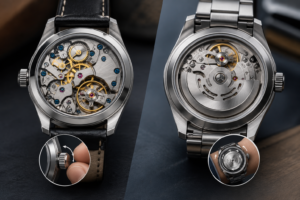
In a mechanical chronograph, a network of gears, levers, springs, and clutches coordinates these actions. The movement transfers energy through carefully arranged components to control the stopwatch hands.
In a quartz chronograph, an electronic circuit and a battery regulate timekeeping, while a stepping motor moves the hands. Both designs provide the same basic function, but their internal mechanisms differ significantly.
The Main Components Behind the Stopwatch Function
Several components work together to make a chronograph operate smoothly.
- Pushers
The pushers are the external controls used to start, stop, and reset the stopwatch. In many traditional designs, the upper pusher starts and stops timing, while the lower pusher resets the hands after the measurement has stopped.
- Chronograph Hands
The central seconds hand typically records elapsed seconds. Smaller subdials may measure elapsed minutes and hours, depending on the movement and dial layout.
- Clutch Mechanism
In mechanical chronographs, the clutch connects the chronograph timing system to the movement when the stopwatch is activated. Different clutch designs influence how the hands begin moving and how the mechanism operates.
- Column Wheel or Cam System
Some mechanical chronographs use a column wheel to coordinate the start, stop, and reset functions. Others use a cam-based switching system. Both approaches control the movement of internal levers, although their construction and operation differ.
- Reset Hammer and Heart-Shaped Cams
When the reset function is activated, a hammer presses against specially shaped cams attached to the chronograph wheels. This returns the stopwatch hands to zero, preparing the mechanism for another measurement.
Chronograph Watch Movements: Mechanical vs Quartz
The movement determines how the stopwatch function is powered and controlled.
Mechanical chronographs rely on a mainspring, gear trains, and mechanical switching components. Automatic versions wind themselves through the motion of the wearer’s wrist, while manual-winding versions require regular winding. Collectors often appreciate mechanical chronographs for their intricate construction and traditional watchmaking techniques.
Quartz chronographs use a battery-powered electronic system to maintain accurate time. They generally require less routine maintenance than mechanical models and can offer precise stopwatch measurements at accessible prices.
Some advanced chronographs also include flyback or split-seconds functions. A flyback chronograph allows the user to reset and restart timing with a single press while the stopwatch is running. A split-seconds chronograph can measure two events that start together but finish at different times.
These additional functions demonstrate how chronograph technology can extend beyond basic elapsed-time measurement.
Why Are Chronograph Watches Popular?
Chronograph watches remain popular because they combine functionality with distinctive design. Their pushers, contrasting subdials, and detailed dial layouts create a technical appearance that appeals to watch enthusiasts.
They also have a strong connection to motorsports, aviation, and professional timing. Drivers can use elapsed-time measurements to monitor laps, while pilots historically relied on chronographs for timing specific stages of a flight. Today, the stopwatch remains useful for exercise sessions, cooking, presentations, and other timed activities.
Beyond their practical uses, chronographs showcase the engineering possibilities of watchmaking. The ability to fit a separate timing mechanism into a compact case demonstrates the precision required to design and manufacture a sophisticated timepiece.
For readers interested in automotive culture, luxury timepieces, and the technology behind performance, GearsMe offers a starting point for exploring the relationship between engineering and lifestyle.
How to Use a Chronograph Correctly
Using a standard chronograph is straightforward. Press the start button to begin measuring elapsed time, press it again to stop, and read the central seconds hand or subdials. Once the measurement has stopped, press the reset button to return the hands to zero.
Always check the manufacturer’s instructions before operating an unfamiliar model. Some advanced mechanisms have specific operating requirements, and water resistance should not be assumed to make the pushers safe to operate underwater.
For a broader introduction to how watches measure time, the National Institute of Standards and Technology provides information about time and frequency measurement.
Conclusion
A chronograph watch combines ordinary timekeeping with a dedicated stopwatch mechanism, bringing practical timing functions into a compact and carefully engineered design. From pushers and clutches to subdials and reset components, every part plays a role in ensuring the stopwatch operates correctly.
Whether powered by a mechanical movement or a quartz system, the chronograph remains an excellent example of how precision engineering and thoughtful design can work together. Its enduring popularity reflects not only its usefulness but also the technical craftsmanship that makes it an important part of modern watchmaking.