

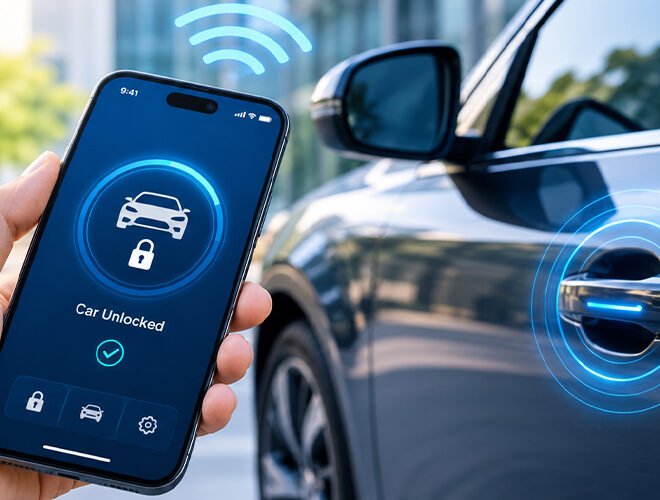

Modern vehicles are increasingly replacing traditional physical keys with smartphone-based access systems. Instead of carrying a separate key fob, drivers can use their smartphones to unlock doors, start the engine and share vehicle access with other people. These features are changing how drivers interact with their cars, making everyday access more convenient and connected.
Digital car keys use wireless communication technologies such as Bluetooth, Near Field Communication (NFC) and Ultra-Wideband (UWB) to communicate securely with compatible vehicles. Depending on the system, drivers may be able to unlock their cars simply by approaching them, tapping their phone against a designated area or using a digital key stored in their smartphone wallet.
However, convenience is only one part of the technology. Security, device compatibility, battery life and access management are equally important when understanding how digital car keys work.
1. What Are Digital Car Keys?
A digital car key is a virtual version of a traditional vehicle key that is stored on a compatible smartphone or wearable device.
Instead of using a physical remote or inserting a key into the ignition, the driver uses an authorised digital credential to access the vehicle.
Depending on the vehicle and smartphone, digital key systems can offer several functions:
- Locking and unlocking vehicle doors.
- Starting the engine or enabling the vehicle to drive.
- Unlocking the boot or tailgate.
- Allowing keyless entry when approaching the vehicle.
- Sharing vehicle access with family members or other authorised drivers.
Some manufacturers integrate digital keys into smartphone applications, while others support digital keys through services such as Apple Wallet or Google Wallet.
The available functions depend on the vehicle model, smartphone compatibility and manufacturer’s implementation.
2. How Do Digital Car Keys Work?
Digital car keys operate through wireless communication between the smartphone and the vehicle’s access system.
When a driver approaches the car or attempts to unlock it, the vehicle checks whether the smartphone has a valid digital key. If the credentials are verified, the system grants the requested access.
Three major wireless technologies are commonly used.
Bluetooth Low Energy (BLE)
Bluetooth Low Energy allows a smartphone to communicate with the vehicle over a wireless connection while using relatively little power.
It can support passive entry, where the vehicle detects an authorised smartphone nearby.
However, Bluetooth proximity alone does not necessarily provide precise distance measurement. This is why some systems combine it with other technologies for improved security and positioning.
Near Field Communication (NFC)
NFC enables communication over a very short distance, usually when the smartphone is held close to a compatible reader.
With an NFC-based digital key, the driver may need to tap the smartphone against the vehicle’s door handle or another designated access point.
This approach is particularly useful when the phone battery is low, provided the device and vehicle support the relevant power-reserve feature.
Ultra-Wideband (UWB)
Ultra-Wideband technology allows compatible devices to determine their relative distance and position with greater precision than ordinary Bluetooth proximity detection.
This helps the vehicle recognise when an authorised smartphone is genuinely nearby.
UWB can support hands-free access, allowing the driver to approach the car, unlock it and start driving without taking the phone out of their pocket or bag.
Not every digital key system supports all three technologies. Some vehicles use a combination, while others rely on a single communication method.
3. How Secure Are Digital Car Keys?
Security is one of the most important considerations when replacing a physical car key with a smartphone.
Digital key systems are designed to use encrypted communication and authentication to prevent unauthorised access. The vehicle checks the digital credentials presented by the smartphone before allowing entry or engine activation.
Several security features help protect these systems:
Encrypted communication: Communication between the smartphone and vehicle uses security mechanisms designed to prevent unauthorised access and interception.
Secure Element: Supported devices can store digital key credentials in a dedicated secure hardware environment, helping protect them from software-based attacks.
Device authentication: Depending on the system, access may require a phone passcode, fingerprint or facial recognition.
Secure distance measurement: UWB technology can help establish whether the authorised device is actually near the vehicle, reducing the risks associated with certain relay attacks.
The Car Connectivity Consortium (CCC) has developed specifications to support secure digital key communication between compatible smartphones and vehicles. Its technology combines authentication and secure ranging for supported implementations.
Car Connectivity Consortium+2
Although these features improve protection, digital keys are not completely risk-free. Users should keep their smartphones updated, protect their device accounts and avoid sharing access credentials with untrusted people.
4. Sharing Digital Car Keys with Family and Friends
One useful advantage of digital car keys is the ability to share vehicle access without physically handing over a key.
Depending on the vehicle and smartphone platform, the owner can send a digital key to another authorised person through a supported application or smartphone wallet.
For example, a car owner may share access with a family member who regularly uses the vehicle.
Some systems also allow owners to:
- Grant access to selected individuals.
- Set an expiry period for shared keys.
- Restrict certain driving functions, where supported.
- Remove access when it is no longer required.
- Provide limited access for service personnel or other users.
Apple Wallet and Google Wallet both support digital car key sharing for compatible vehicles, although the available permissions depend on the manufacturer’s implementation.
Google Wallet Help+1
This feature can be particularly useful for households with multiple drivers because it reduces the need to maintain and distribute several physical keys.
5. What Happens If Your Smartphone Battery Dies?
A common concern among drivers is what happens when their smartphone runs out of battery.
Some digital car key systems offer a power reserve feature that allows the key to continue working for a limited period after the phone battery is depleted.
For example, supported iPhones can use certain car keys in Apple Wallet through Power Reserve. Google also documents low-battery access for supported Android devices and vehicle configurations.
However, this functionality is not available on every phone or vehicle. The duration and supported functions can also vary.
Google Wallet Help+1
Before relying entirely on your smartphone, check the manufacturer’s emergency access instructions. Keeping a physical backup key where appropriate is also a sensible precaution.
6. How to Set Up a Digital Car Key
Setting up a digital car key is generally straightforward, although the exact process varies by manufacturer.
Most compatible vehicles follow a similar procedure:
- Download the vehicle manufacturer’s official smartphone application.
- Create an account and connect it to your vehicle.
- Locate the digital key setup option.
- Follow the pairing instructions displayed on your phone or vehicle screen.
- Add the key to a supported wallet application, if required.
- Complete any verification or activation steps.
- Test the locking, unlocking and starting functions.
For supported vehicles, the key may be stored in Apple Wallet, Google Wallet or Samsung Wallet.
You can refer to the official setup instructions from Apple Support and Google Wallet Help for additional guidance.
7. Digital Car Keys vs Traditional Key Fobs
Although both systems provide vehicle access, they offer different advantages.
| Feature | Digital Car Key | Traditional Key Fob |
| Access device | Smartphone or smartwatch | Physical remote |
| Unlocking | NFC, Bluetooth or UWB, depending on the system | Radio-frequency communication |
| Key sharing | Digital sharing on supported vehicles | Requires physical handover or an additional fob |
| Access management | Can support remote permission management | Usually limited |
| Battery dependency | Depends on smartphone power and supported reserve features | Depends on key-fob battery |
| Compatibility | Requires a supported vehicle and device | Depends on the vehicle’s key system |
Digital keys offer greater flexibility, particularly when sharing access or managing multiple drivers. However, traditional key fobs remain useful because they do not depend on a smartphone’s operating system, wallet application or device compatibility.
Many manufacturers continue to provide physical keys alongside digital access options.
8. What Are the Limitations of Digital Car Keys?
Despite their convenience, digital car keys have some limitations that buyers should understand before choosing a vehicle.
Device compatibility: Not every smartphone supports digital car key functionality. Some features are limited to selected devices and operating system versions.
Vehicle compatibility: Digital key availability depends on the manufacturer, model, year and market. A vehicle may support smartphone connectivity without supporting a full digital key system.
Software dependency: Pairing and access management may require manufacturer applications, account verification and software updates.
Battery concerns: Although some devices support low-battery access, not every digital key offers the same backup functionality.
Connectivity and technical issues: Software problems, incorrect settings or device changes can occasionally interrupt access.
Before purchasing a vehicle, check whether its digital key features work with your existing smartphone. Also confirm whether passive entry, remote locking and key sharing are included.
9. The Future of Smartphone-Based Vehicle Access
Digital car keys are becoming part of the wider connected-car experience. As smartphone and automotive technologies develop, vehicle access systems are expected to offer more integration with other digital services.
Future developments may include improved compatibility across different smartphone brands, more flexible access permissions and better integration with connected vehicle applications.
The Car Connectivity Consortium continues to develop common standards intended to improve interoperability between vehicle manufacturers and mobile device providers.
This could make digital keys easier to use across different vehicle brands and smartphone platforms, although widespread compatibility will depend on industry adoption.
Final Thoughts
Digital car keys are changing how drivers access and manage their vehicles. By combining smartphone technology with Bluetooth, NFC and UWB communication, they offer a convenient alternative to traditional physical keys.
Features such as hands-free entry, secure authentication and digital key sharing make them particularly useful for modern connected vehicles.
However, compatibility, smartphone battery life and security settings should be considered before relying entirely on digital access.
As more manufacturers introduce smartphone-based vehicle access, digital car keys are likely to become an increasingly important feature in the next generation of automobiles.