
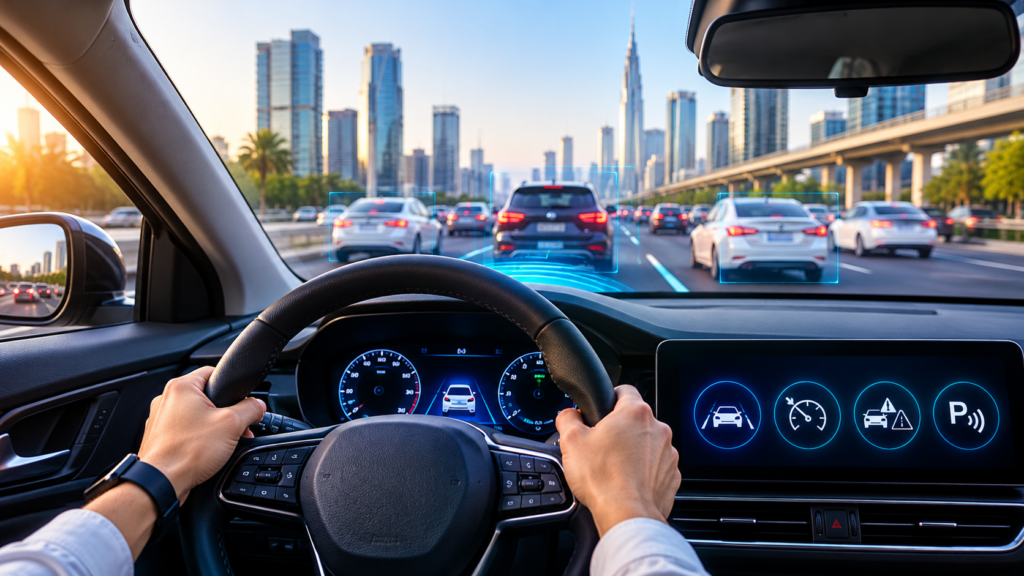

Driving in the city can be challenging, especially during rush hour. Frequent braking, changing lanes, tight parking spaces, pedestrians and unpredictable traffic all demand attention. Choosing a car with the right features can make everyday journeys more comfortable, convenient and less stressful.
Modern vehicles offer much more than powerful engines and comfortable seats. Parking cameras, light steering, automatic braking, blind-spot monitoring and intuitive infotainment systems can help drivers handle busy urban roads with greater confidence.
For motorists in the UAE, these features can be particularly useful when navigating crowded streets in Dubai, Abu Dhabi and Sharjah. However, the best city car is not necessarily the one with the most technology. It is the one that feels easy to control, offers good visibility and suits the driver’s daily routine.
Here are the features worth considering when evaluating a car for city driving.
1. Light Steering Makes Tight Turns Easier
Steering plays an important role in how a car feels in traffic. A vehicle with light, responsive steering is generally easier to manoeuvre through narrow streets, roundabouts and busy junctions.
Electric power steering is common in modern cars and can adjust steering assistance according to driving conditions. Lighter steering at lower speeds can make parking and U-turns more convenient, while firmer steering at higher speeds can provide a more stable feel.
However, steering systems differ between vehicles. Some drivers prefer a light setup, while others find a slightly heavier steering response more predictable.
During a city driving test, pay attention to how easily the car turns into side streets, moves through roundabouts and handles slow-speed manoeuvres. The steering should feel natural rather than requiring unnecessary effort.
2. A 360-Degree Camera Helps With Parking
Parking can be one of the most difficult parts of driving in a busy city. Narrow parking bays, pillars, kerbs and vehicles parked close together can make it harder to judge the available space.
A rear-view camera provides a view behind the car, while parking sensors use audible or visual alerts to indicate when an obstacle is nearby. A 360-degree camera system combines views from multiple cameras to create an overhead-style image of the vehicle and its surroundings.
These features can be especially useful when parking in crowded shopping centres, apartment complexes and underground car parks across the UAE.
Some vehicles also offer automatic parking assistance, which can help steer the car into a suitable space. The driver’s involvement varies depending on the system.When testing a car, check whether the camera image is clear, whether the parking guidelines are easy to understand and whether the sensors provide useful warnings. Cameras and sensors can have blind spots, so drivers should still check their surroundings directly.
3. Automatic Emergency Braking Adds an Extra Safety Layer
City traffic often involves sudden stops. A vehicle ahead may brake unexpectedly, or a pedestrian may enter the road when the driver has limited time to react.
Automatic emergency braking (AEB) uses sensors and vehicle systems to identify certain potential collisions and can apply the brakes when intervention is necessary. Forward collision warning may alert the driver when the system detects a possible crash.
Depending on the vehicle, some systems can also detect pedestrians or cyclists in particular situations.The US National Highway Traffic Safety Administration’s guide to driver-assistance technologies explains how these features work and what drivers should understand about their limitations.
When comparing cars, check whether automatic emergency braking is included as standard or offered only on higher trims. Also confirm which types of obstacles the system can detect.AEB can support safer driving, but it cannot prevent every collision. Drivers must maintain a safe distance, remain alert and be ready to brake themselves.
4. Blind-Spot Monitoring Helps With Lane Changes
Changing lanes in busy traffic requires drivers to check their mirrors, look over their shoulders and judge the movement of surrounding vehicles. Large SUVs can make this task more challenging because of their size and visibility limitations.
Blind-spot monitoring uses sensors to detect vehicles in adjacent areas that may not be visible in the mirrors. Depending on the system, a warning may appear in the side mirror or on the dashboard. Some vehicles offer additional steering or braking intervention if a potential collision is detected.
This feature can be useful when merging onto busy roads, moving between lanes or navigating multi-lane routes in Dubai and Abu Dhabi.
However, blind-spot monitoring should never replace mirror checks or looking over your shoulder. Motorcycles, fast-moving vehicles and other road users may be difficult for some systems to detect in certain conditions.During a test drive, check where the warning appears, whether it is easy to notice and whether the alerts are clear without being distracting.
5. Adaptive Cruise Control Is More Useful on Open Roads
Adaptive cruise control adjusts a vehicle’s speed to maintain a selected distance from the vehicle ahead. Some advanced systems can slow the car to a stop and resume moving when traffic starts again, depending on the vehicle and operating conditions.
For regular city driving, its usefulness depends on the traffic. In slow-moving, stop-start conditions, a compatible traffic-jam assistance feature may reduce some of the work involved in controlling speed. On open roads and highways, adaptive cruise control can be more consistently useful.
For example, Mercedes-Benz’s driver-assistance features include its DISTRONIC system, which can maintain a set distance and speed and, in supported conditions, stop and resume driving.
When evaluating this feature, check how smoothly the vehicle slows down, whether its following-distance settings suit your preferences and what conditions are required for the system to operate.
Adaptive cruise control is a support feature, not a replacement for the driver. Keep your attention on the road and be prepared to take control.
6. Good Visibility Makes Urban Driving Less Stressful
A car can have plenty of advanced technology and still be difficult to drive if visibility is poor. Large pillars, small rear windows and high bonnet lines can make it harder to judge distances and spot other road users.
A good driving position allows the driver to see clearly through the windscreen and side windows. Well-positioned mirrors and adjustable seats also help drivers find a comfortable view of the road.This is particularly important when turning at junctions, entering roundabouts and driving near pedestrians.
Before buying a car, check whether the seat and steering wheel offer sufficient adjustment. Test the rear view and look for areas hidden by the pillars. If the vehicle has a rear camera or 360-degree camera, use it during parking manoeuvres rather than relying only on the showroom demonstration.
For more practical buying advice, read our guide on what to look for during a car test drive.
7. Smooth Transmission and Low-Speed Control Matter
Driving in the city means repeatedly accelerating, slowing down and moving off again. A transmission that responds smoothly can make these situations more comfortable.
Automatic transmissions are popular for urban driving because they remove the need for frequent clutch operation and manual gear changes. However, the way a vehicle responds at low speeds matters more than the transmission type alone.
During a test drive, observe whether the car moves away smoothly, whether acceleration is easy to control and whether the brakes respond predictably in stop-start traffic.
Electric vehicles can also be convenient in city conditions because their power delivery is generally smooth and quiet. However, regenerative braking behaviour differs between models, so drivers should check whether they find the deceleration response comfortable.
The best choice is a vehicle that feels predictable when moving through queues, approaching junctions and parking at low speeds.
8. An Easy-to-Use Infotainment System Reduces Distractions
Modern cars increasingly rely on touchscreens for navigation, music, phone connectivity and vehicle settings. While these systems offer convenience, complicated menus can distract drivers from the road.
For city driving, a clear display, straightforward controls and reliable smartphone integration can be more useful than a large screen packed with features.
Voice commands can help drivers request directions or change audio settings without navigating multiple menus. Physical buttons for frequently used functions, such as climate control or demisting, can also make adjustments easier.
During a test drive, connect your phone if possible and check how quickly you can access navigation, adjust the temperature and control audio. Make sure the system is intuitive before considering it a benefit.
Avoid interacting with menus while the vehicle is moving. Set your route and preferences before starting your journey.
9. A Compact Size and Good Parking Visibility Can Make a Difference
Vehicle dimensions have a direct effect on how easy a car feels in crowded urban environments. Smaller hatchbacks and compact SUVs are often easier to position in narrow streets and fit into tighter parking spaces than larger vehicles.
That does not mean a large SUV is unsuitable for city use. A higher seating position, good camera coverage and light steering can make a larger vehicle manageable. However, drivers should consider whether its width and turning circle suit their regular routes.
Think about where you usually park, the width of your residential parking space and whether you frequently drive through narrow streets.
The most practical city car is one that fits your environment without making everyday manoeuvres unnecessarily difficult.
10. Which Features Should You Prioritise?
Not every driver needs every available system. The most useful features depend on driving habits, vehicle size and the type of roads travelled most often.
For frequent city commuters, the following features deserve particular attention:
- For parking: Rear-view camera, parking sensors and, where useful, a 360-degree camera.
- For busy traffic: Automatic emergency braking and forward collision warning.
- For lane changes: Blind-spot monitoring and clear mirror visibility.
- For stop-start journeys: Smooth low-speed response and comfortable automatic transmission behaviour.
- For regular highway travel: Adaptive cruise control and suitable lane-assistance features.
- For everyday convenience: Easy-to-use navigation, smartphone connectivity and accessible climate controls.
It is also worth checking which features are included in the specific trim sold in the UAE. Equipment can differ between model years and regional specifications.
Conclusion
The best features for city driving are those that make everyday manoeuvres easier, improve awareness and reduce unnecessary effort. Light steering, good visibility, parking assistance, automatic emergency braking and intuitive controls can all contribute to a more comfortable urban driving experience.
For UAE motorists, the right choice depends on where and how often they drive. Someone navigating narrow streets and crowded parking areas may prioritise compact dimensions and camera systems, while a regular commuter may value driver-assistance technology and comfortable low-speed performance.
During your next test drive, focus on how the car feels in real traffic rather than relying only on its feature list. A vehicle that is easy to see out of, simple to control and comfortable in everyday conditions may prove more useful than one with technology you rarely need.
Frequently Asked Questions
1. Which car features are most useful for city driving?
Light steering, parking sensors, a rear-view camera, good visibility, automatic emergency braking and easy-to-use controls are among the most useful features for urban driving.
2. Is a 360-degree camera worth having in a city car?
It can be helpful when parking in tight spaces or manoeuvring a larger vehicle. However, drivers should still check their surroundings because cameras cannot show every obstacle in every situation.
3. Is adaptive cruise control useful in traffic?
It can help maintain a following distance and adjust speed in suitable conditions. Its usefulness in stop-start traffic depends on whether the vehicle supports low-speed or traffic-jam operation.
4. Are compact cars easier to drive in busy cities?
Compact cars are often easier to manoeuvre and park because of their smaller dimensions. However, visibility, steering, turning circle and parking assistance also influence how easy a car is to drive.
5. Should I choose a car with more driver-assistance features?
Not necessarily. Prioritise features that suit your driving needs, understand their limitations and check whether they are included in the exact vehicle specification you are buying.