

With more than 3,000 horsepower and four electric motors, the Chinese hypercar has achieved something that even the biggest names in the automotive industry have struggled to accomplish.
By Fahed Abu Salah | GearsMe
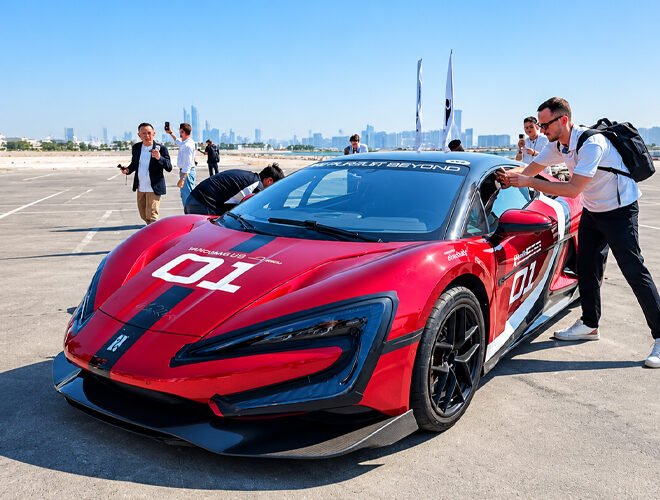
503.17 km/h. That’s the speed the BYD Yangwang U9 Xtreme managed to reach on a closed public road in Abu Dhabi, making it the first production-based car to cross the 500 km/h barrier in a recorded single-direction run.
The achievement took place on November 1, 2026, on Sheikh Khalifa Bin Zayed International Road, where approximately 10 kilometres of road were closed for the attempt. Behind the wheel was German racing driver Marc Basseng, the same man who drove the U9 Xtreme to 496.22 km/h in Germany back in September 2025.
I find this achievement particularly interesting, not just because of the speed itself, but because of the manufacturer behind it. We’re talking about a Chinese electric car that has now gone faster than the Bugatti Chiron Super Sport 300+, which reached 490.484 km/h in 2019.
A few years ago, very few people would have expected a Chinese manufacturer to be setting this kind of benchmark, especially in a segment traditionally dominated by European brands with decades of experience building high-performance cars.
But BYD has clearly demonstrated that it has the technology, resources and engineering capabilities to compete at this level.

More Than 3,000 Horsepower, and No Petrol Engine
The Yangwang U9 Xtreme is based on the regular U9 electric supercar, although the modifications go far beyond increasing its power output.
The standard U9 already produces around 1,287 PS, which is an impressive figure by any standard. The Xtreme takes that number to approximately 3,018 PS, or 2,220 kW, using four electric motors, one for each wheel.Each motor produces up to 555 kW and can operate at an extraordinary 30,000 rpm. For comparison, most conventional petrol engines operate at a fraction of that rotational speed.
The car weighs approximately 2,480 kg, which is certainly not lightweight compared with traditional combustion-engine supercars, but with this much power available, its power-to-weight ratio reaches around 1,217 PS per tonne.
Another important difference is the electrical system. While the regular U9 uses an 800-volt architecture, the Xtreme features a 1,200-volt system, developed to handle the enormous electrical demands of its four motors.
It also uses a specially developed BYD Blade Battery with lithium iron phosphate chemistry and a 30C discharge capability, allowing extremely high levels of power delivery. The cooling system has been substantially upgraded to deal with the heat generated during high-performance driving.And this is where things become interesting, because producing more than 3,000 horsepower from electric motors is one challenge, but maintaining that power long enough to reach 500 km/h is something completely different.
What Does It Take to Reach 503 km/h?
At that speed, the car is covering almost 140 metres every second. Everything becomes critical, from the tyres and aerodynamics to the suspension, battery temperatures and even the condition of the road.
The U9 Xtreme uses BYD’s DiSus-X active suspension system, which continuously adjusts the vehicle’s body control, along with the e4 four-motor platform that manages torque distribution between individual wheels.The car also features revised aerodynamic components, including a large rear wing, front splitter and rear diffuser, developed to provide the stability needed at extremely high speeds.
Perhaps one of the most important components is the tyres. BYD worked with Giti to develop specialised GitiSport semi-slick tyres capable of dealing with the forces generated at speeds exceeding 500 km/h.For the Abu Dhabi record attempt, the team had to deal with conditions quite different from those found at a dedicated European testing facility. Desert sand, road temperature and crosswinds were among the factors that needed to be considered.
The first runs reportedly reached around 490 km/h, before the engineers made further adjustments to the car’s setup, including the suspension, aerodynamics and tyre pressures.Those changes helped the U9 Xtreme finally exceed the 500 km/h mark.It is worth mentioning that this was a single-direction speed record rather than a two-way average, which is an important distinction when comparing different top-speed achievements.
It Has Also Completed the Nürburgring in Under Seven Minutes
What makes the U9 Xtreme more interesting is that BYD hasn’t focused exclusively on straight-line performance.The car has also completed a lap of the Nürburgring Nordschleife in 6 minutes and 59.157 seconds, becoming one of the fastest electric production-based cars to lap the famous German circuit.
That is an impressive result for a vehicle weighing nearly two and a half tonnes, particularly considering the demanding nature of the Nürburgring, with its high-speed corners, elevation changes and challenging braking zones.Of course, a lap time and a top-speed record are not enough to tell us whether a car is genuinely enjoyable to drive.
Steering feel, braking consistency, driver involvement and the way a car behaves when pushed through corners are just as important, particularly when we’re talking about vehicles competing in the hypercar segment.I would still like to see how the U9 Xtreme compares with established European performance cars in a proper back-to-back driving test, rather than judging it solely by its impressive numbers.
Only 30 Examples Will Be Produced
BYD plans to build no more than 30 examples of the Yangwang U9 Xtreme worldwide, making it an extremely exclusive model.The U9 Xtreme is clearly more than another electric sports car in BYD’s portfolio. It also serves as a demonstration of what the company can achieve with its electric powertrain technology, battery development and advanced vehicle-control systems.
Not everything developed for this car will necessarily find its way into regular BYD models, but the knowledge gained from projects like this can play an important role in developing future vehicles.And for a manufacturer that has grown rapidly in the global automotive market, achieving this kind of result also sends a clear message to competitors.
What Does This Mean for the Automotive Industry?
I don’t think the Yangwang U9 Xtreme’s record means Chinese manufacturers have suddenly become better than every European performance-car brand. That would be an exaggeration, and the automotive industry is far more complicated than that.Bugatti, Ferrari, Porsche, Lamborghini and Koenigsegg have spent decades developing cars that offer much more than impressive acceleration or top-speed figures. Their engineering, driving characteristics, brand heritage and overall ownership experiences are difficult to replicate.
But we also shouldn’t underestimate what BYD has achieved here.
The Chinese automotive industry has developed at an extraordinary pace, particularly in battery technology, electric motors and vehicle electronics, and we’re now seeing the results in cars that compete at the very highest performance levels.For me, the most significant part of this record is that a Chinese manufacturer has managed to achieve something that many of the world’s most established hypercar brands have been chasing for years.It doesn’t automatically make the Yangwang U9 Xtreme the best hypercar in the world, and I certainly wouldn’t make that judgment without driving it.
But 503.17 km/h from a production-based electric car is an extraordinary engineering achievement, regardless of where the car was developed.And the fact that it happened here in the UAE makes the story even more interesting for our region.The automotive industry is changing quickly, and records like this show just how seriously we need to take the new generation of Chinese performance cars.
More automotive news and reviews on www.gearsme.com