

Car manufacturers tell us at every show that AI voice control in cars is the revolution that will transform our relationship with our vehicles. Therefore, the Consumer Electronics Show in Las Vegas became the primary stage where car brands desperately prove they are not a legacy industry. Furthermore, AI voice control was the most prominent buzzword at this year’s show by a considerable margin. Based on this, the topic deserves an honest and direct assessment completely separate from the marketing noise of exhibition floors. So, here is GearsME’s final verdict on this technology for every reader across the Middle East and Gulf. Ultimately, humanity is for humans — and that matters more than any demo ever will.

What Gets Shown at Motor Shows: A Picture That Doesn’t Match Reality
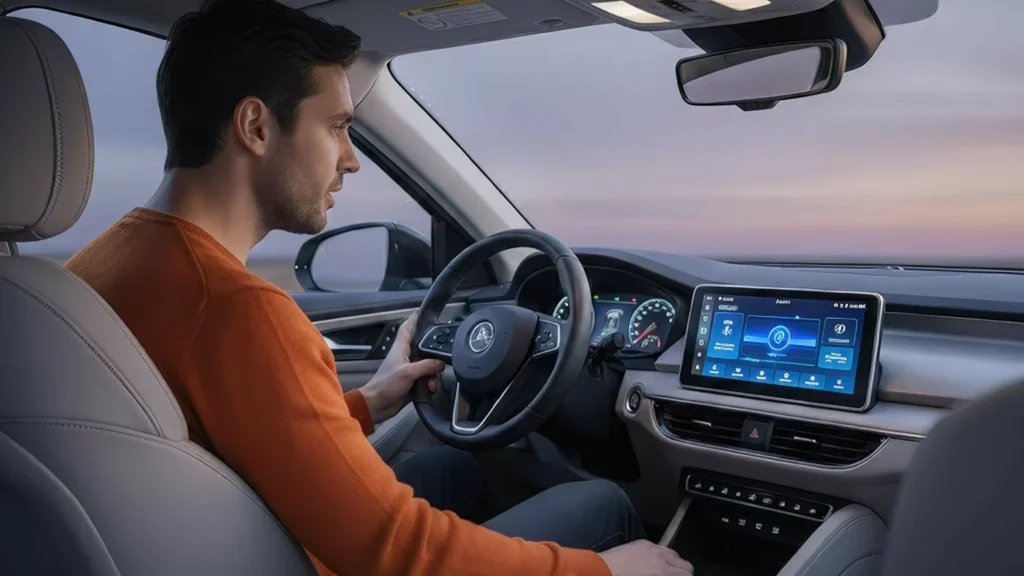
The AI voice control in cars demonstrations look genuinely impressive inside the polished halls of CES. Therefore, trained operators ask their cars to adjust climate settings, schedule meetings by checking availability and navigate to destinations based on vague requests like “find me a good Italian restaurant.” Furthermore, system developers claim their cars can now hold simultaneous conversations with multiple passengers in the same vehicle. Additionally, they invoke AI capabilities described as human-adjacent and fundamentally superior to anything that came before.
Based on this, every demonstration looks compelling inside the show floor environment. Consequently, real road experience consistently tells a very different story — and that gap is where the truth lives.
The Big Promise: Simultaneous Multi-Person Conversations
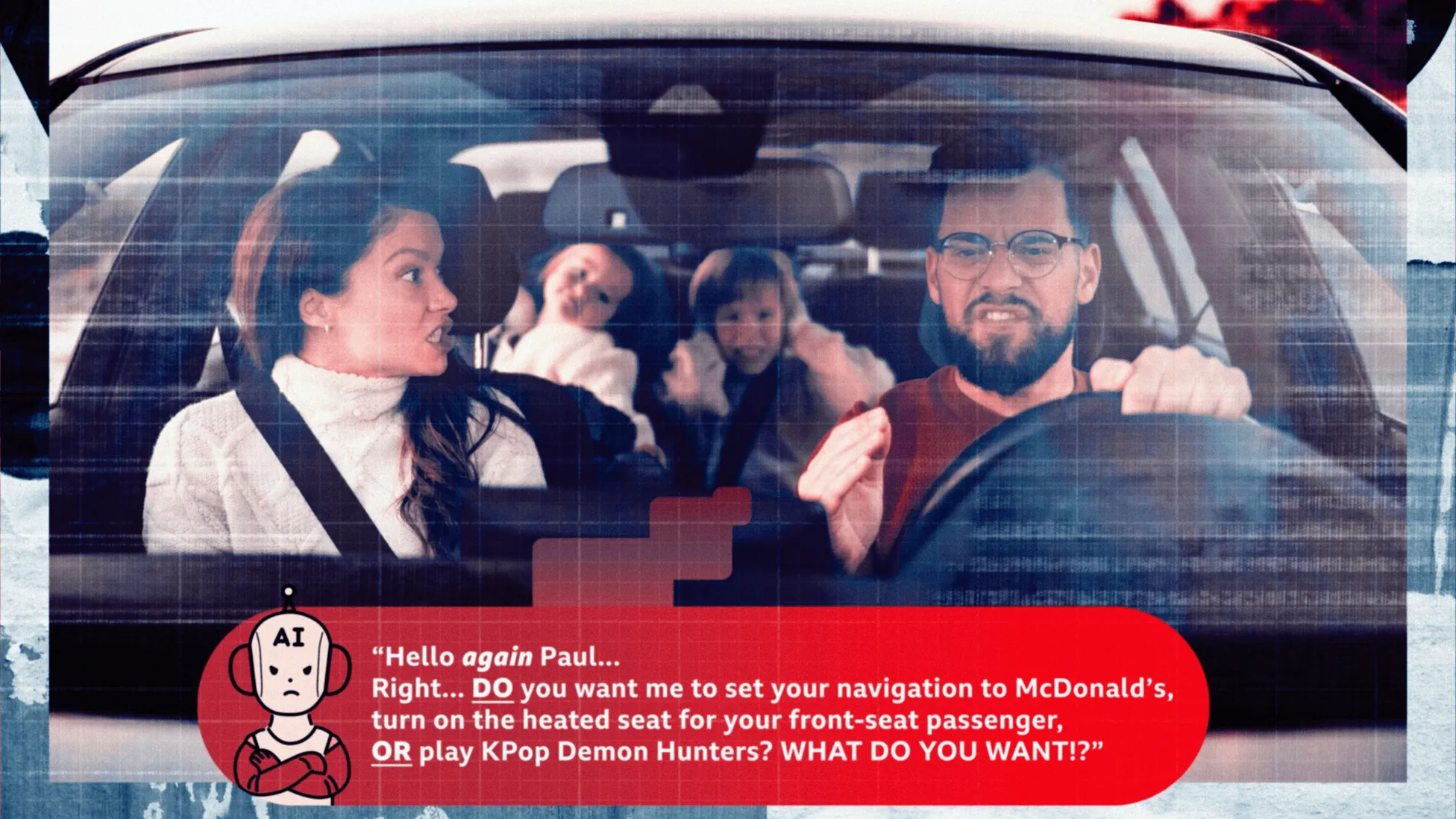
Developers make one specific promise that does address a real frustration. Therefore, if your car can genuinely hold separate conversations with different passengers simultaneously it solves a problem every family knows intimately. Furthermore, the classic failure moment — driver and passenger both speak at once and the system collapses completely — is a documented reality with every voice assistant in every car produced in the last decade. Additionally, the technical ability to distinguish between multiple speakers and process each request independently represents a genuinely non-trivial engineering challenge.
Based on this, acknowledging that other people exist in the car alongside the driver proves that developers are paying attention. Consequently, acknowledging the problem and actually solving it are two entirely different achievements — and the gap between them is currently wider than most manufacturers will admit.
Solving a Problem That Does Not Exist
The fundamental comedy of this technology reveals itself with straightforward logical thinking. Therefore, why would a passenger hold a verbal conversation with the car’s dashboard to find a restaurant? Furthermore, any passenger with a phone — which means every passenger in every car in 2026 — will search themselves and find the answer faster than any voice system could respond. Additionally, the only moment a passenger might genuinely speak to the car is when they want a confirmed address entered into the navigation system — and even then a quick tap on the touchscreen gets there faster and more reliably.
Based on this, AI voice control in cars in this context creates a need that did not exist and then presents itself as the solution to that need. Consequently, this marketing pattern is common across the technology industry — but it persuades nobody who applies basic logic to the proposition.
The Engineering Failure Signal: Heated Seat by Voice Command
This is where the argument becomes completely unanswerable. Therefore, if you need to use your voice to activate the heated seat you are looking at clear and definitive evidence of poor ergonomic design in the car rather than proof of artificial intelligence success. Furthermore, a heated seat control must be obvious — either on the screen as a clearly labelled button or as a physical switch in an intuitive location. Additionally, when voice becomes the solution to a function that should have an obvious visible control the underlying problem is interface design failure not missing AI capability.
Based on this, AI voice control in cars in this scenario conceals an ergonomic failure behind a shiny technology wrapper. Consequently, this is not progress — it is an escape from the real problem dressed up as innovation.
The Connectivity Problem: The Foundation That Does Not Hold
Every promise made about AI voice control in cars rests on one foundational assumption. Therefore, the assumption is that the car maintains a strong and stable internet connection at all times and in all locations. Furthermore, every driver in the world has experienced dropped calls, delayed messages and navigation systems losing their connection on roads that are perfectly ordinary and heavily used. Additionally, a monthly mobile network subscription does not buy guaranteed signal quality in a tunnel, on a rural road or in a car park basement.
Based on this, every feature designed around a strong stable signal will fail at the worst possible moment with complete predictability. Consequently, AI voice control in cars is a conditionally functional technology entirely dependent on infrastructure maturity that has not yet reached the required standard in the majority of real-world driving environments.
The Real Question: Does Anyone Actually Want to Talk to a Bot?
Here sits the most honest question in this entire debate. Therefore, human interaction carries a quality and intimacy that no language model can replicate regardless of how sophisticated its training data becomes. Furthermore, nobody driving to work at 7am across Dubai or Riyadh genuinely wants their daily commute to become a conversation with a digital servant performing theatrical humanity. Additionally, human connection is an experience rather than simply a function — and that distinction is precisely what artificial intelligence cannot bridge regardless of how many parameters it processes.
Based on this, AI voice control in cars solves a functional problem while simultaneously making the act of driving feel less human rather than more capable. For the latest automotive technology analysis across the Middle East, follow GearsME. For the original Top Gear article, visit Top Gear. Consequently, the technology industry can label anything AI — but adding intelligence to a problem does not automatically make the problem worth solving.
What Would Actually Useful Voice Control Look Like?
To be fair to the technology there is a version of AI voice control in cars that would genuinely earn its place. Therefore, fast and accurate single-command execution with zero conversational overhead would be useful — “navigate to the nearest petrol station” delivered and confirmed in two seconds without a follow-up question asking which one. Furthermore, reliable offline functionality that works without a network connection would transform the technology from a party trick into a genuine tool. Additionally, a system that learns your specific preferences over time without requiring you to repeatedly confirm them would add real daily value.
Based on this, the gap between what gets demonstrated at CES and what would actually serve a real driver on a real road in 2026 is enormous. Consequently, the technology exists to make voice control genuinely useful — but the incentive to deliver demo-friendly showmanship consistently overrides the incentive to deliver functional daily reality.
Final Thoughts: A Technology Looking for a Justification
Ultimately, AI voice control in cars in 2026 is a technology that performs well on exhibition floors and struggles to justify itself on real roads in daily driving conditions. Furthermore, solving a problem that does not exist with technology constrained by unreliable connectivity inside a car that cannot design an obvious heated seat button is not a vision of the future — it is a distraction from the questions that actually matter. Consequently, humanity is for humans. The car industry would do well to remember that before adding AI to everything it builds.