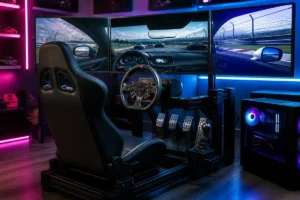



Driving a car on an actual road and racing in a virtual environment may appear similar, but the experience is quite different. Both require steering control, braking, acceleration and an understanding of vehicle behaviour. However, the conditions, physical feedback and skills involved can vary significantly. Let’s check Key Differences in Skills, Controls and Experience in Real Driving vs Sim Racing.
The comparison between real driving vs sim racing has become increasingly relevant as racing simulators continue to improve. Modern simulators offer realistic steering wheels, force feedback, responsive pedals and detailed track environments that recreate many aspects of motorsport.
While sim racing can help drivers understand racing techniques and improve certain driving skills, it cannot completely reproduce the challenges of operating a real vehicle. Understanding these differences helps explain what each experience offers.
1. Physical Environment: Real Roads vs Virtual Tracks
The most obvious difference is the environment in which the driving takes place.
Real driving involves navigating physical roads, dealing with changing traffic conditions and responding to unpredictable situations. Drivers must consider pedestrians, road signs, weather, road surfaces and other vehicles.
Sim racing takes place in a digitally created environment. Players compete on virtual tracks or roads using racing equipment connected to a computer or gaming console.
The main differences include:
- Real driving: Involves actual road conditions, traffic, weather and physical surroundings.
- Sim racing: Uses virtual tracks, simulated weather and computer-controlled or online competitors.
- Real driving: Requires awareness of unpredictable road situations.
- Sim racing: Focuses primarily on racing performance and vehicle control within the simulator.
Although modern simulators recreate many real-world conditions, they cannot fully reproduce the unpredictability of actual road travel.
2. Steering, Braking and Acceleration Controls
Both experiences involve the same basic driving controls, but the way drivers interact with them is different.
In a real car, the steering wheel, accelerator and brake pedals are connected to actual vehicle systems. Their response depends on the vehicle’s mechanical and electronic characteristics.
In sim racing, these controls are connected to a gaming system that translates driver inputs into virtual vehicle movements.
Steering: Real vehicles provide physical feedback through the steering system, while racing simulators use force-feedback motors to recreate steering resistance and road effects.
Braking: Actual brakes operate through a physical braking system. Sim racing pedals reproduce braking input electronically, with advanced load cell pedals measuring applied pressure.
Acceleration: In a real car, pressing the accelerator controls engine or motor output. In a simulator, the pedal sends an electronic input that determines virtual acceleration.
The quality of sim racing equipment can significantly influence how realistic these controls feel.
3. Skills Required for Real Driving and Sim Racing
Although both activities involve vehicle control, they develop different skill sets.
Real driving requires a combination of technical ability, awareness and decision-making. Drivers must monitor their surroundings, maintain safe distances, follow traffic rules and respond to unexpected situations.
Sim racing focuses more heavily on racing techniques and performance.
Some important sim racing skills include:
- Racing line selection.
- Corner entry and exit techniques.
- Braking points and consistency.
- Throttle control.
- Vehicle balance and weight transfer.
- Race strategy and tyre management.
These techniques can improve a driver’s understanding of vehicle dynamics. However, sim racing skills do not automatically make someone a safe or qualified road driver.
Real-world driving experience and proper training remain essential.
4. Vehicle Feedback and Physical Sensations
One major difference between real driving and sim racing is the amount of physical feedback available.
When driving a real car, the driver experiences acceleration, braking forces, road vibrations, body movement and changes in vehicle balance.
Sim racing attempts to recreate some of these sensations through force feedback, vibration systems and motion platforms.
For example, a direct-drive steering wheel can reproduce changes in steering resistance, while advanced simulator rigs may simulate vehicle movement.
However, most home racing setups cannot reproduce the full physical forces experienced inside an actual vehicle.
This difference becomes particularly noticeable during hard braking, rapid acceleration and high-speed cornering.
5. Safety and Risk Factors
Safety is another important distinction between these two activities.
Real driving involves genuine risks. Mechanical failures, poor road conditions, driver errors and unpredictable traffic situations can lead to accidents.
Sim racing takes place in a virtual environment, so mistakes generally do not create the same physical consequences.
However, this does not mean that real driving habits can be ignored when using a simulator. Sim racing should not encourage dangerous behaviour on public roads.
| Factor | Real Driving | Sim Racing |
| Environment | Physical roads and tracks | Virtual environments |
| Accident risk | Real-world physical risk | No comparable vehicle collision risk |
| Safety requirements | Traffic laws and driving precautions | Responsible equipment use |
| Mistakes | Can cause actual damage or injury | Usually affect virtual race performance |
| Training | Requires real-world instruction | Can support learning racing techniques |
For this reason, sim racing is best viewed as a motorsport simulation and entertainment activity rather than a replacement for professional driving instruction.
6. Cost and Equipment Requirements
Getting started with real driving and sim racing involves very different costs.
Real driving requires access to a vehicle, fuel or charging, insurance, maintenance and other ownership expenses.
Sim racing has a different entry point. A beginner can start with a gaming console or PC and a basic racing wheel. More advanced users can gradually invest in dedicated equipment.
A typical sim racing setup may include:
- Gaming PC or compatible console.
- Force-feedback steering wheel.
- Accelerator and brake pedals.
- Dedicated racing seat or cockpit.
- Racing monitor or virtual reality headset.
- Compatible racing simulation software.
Entry-level equipment is generally more affordable than building a complete professional-grade simulator. However, advanced direct-drive wheels, load cell pedals and fixed racing cockpits can increase the overall investment.
7. Learning Tracks and Racing Techniques
One area where sim racing offers a useful advantage is learning racing circuits.
Many racing simulators recreate well-known international circuits with detailed layouts, corners, braking zones and track characteristics.
Players can practise the same circuit repeatedly, experiment with different racing lines and analyse their lap times.
Real-world track driving involves additional factors, including actual surface conditions, tyre temperature, physical forces and changing weather.
Sim racing can therefore help enthusiasts understand circuit layouts and racing techniques, but real track experience remains necessary to understand how a car behaves under actual conditions.
8. Popular Sim Racing Games and Platforms
Several racing simulators offer different driving experiences, from competitive circuit racing to realistic vehicle physics.
Some popular options include:
Assetto Corsa: Known for its vehicle physics, track selection and extensive modding community.
iRacing: Popular for organised online competitions, structured racing series and competitive multiplayer experiences.
Assetto Corsa Competizione: Focuses on GT racing and officially licensed GT racing cars and circuits.
Gran Turismo 7: Offers a broad selection of vehicles, racing events and accessible console-based simulation experiences.
Forza Motorsport: Combines circuit racing, vehicle customisation and competitive racing features.
The best choice depends on your preferred racing style, gaming platform and equipment compatibility.
9. Can Sim Racing Improve Real Driving Skills?
Sim racing can help develop certain skills that are relevant to vehicle control, particularly for people interested in motorsport.
Repeated practice can improve hand-eye coordination, reaction timing, track awareness and understanding of braking and cornering techniques.
It can also help users understand concepts such as understeer, oversteer, racing lines and weight transfer.
However, these benefits have limitations.
A simulator cannot fully teach drivers how to judge real-world distances, respond to unexpected road users or experience the physical consequences of vehicle movement.
It should therefore be treated as a complementary learning experience rather than a substitute for real-world driving practice.
Final Thoughts
The comparison between real driving vs sim racing highlights two different experiences built around similar driving principles.
Real driving requires practical vehicle handling, road awareness and responsible decision-making. Sim racing focuses more on virtual vehicle control, competitive racing techniques and track performance.
While advanced simulators can recreate many aspects of motorsport, they cannot completely replace the physical experience of driving a real car.
For automotive enthusiasts, both offer something valuable. Real driving provides genuine road and vehicle experience, while sim racing offers an accessible way to explore motorsport, practise racing techniques and enjoy competitive driving from home.