


Fahed Abu Salah speaks with Yousef Bouhaddioui, Regional Brand Director for American and Italian Brands at Stellantis Middle East, about Jeep’s evolving strategy, the decision to introduce smaller engines, the future of V8 power and the brand’s ambitions in the region.
By Fahed Abu Salah | GearsMe
Jeep is entering a new chapter in the Middle East, introducing refreshed versions of two of its most important SUVs, the Grand Cherokee and Grand Wagoneer, while reassessing how its vehicles are positioned in an increasingly competitive market.
For a brand that has built much of its reputation around off-road capability, powerful engines and unmistakable American character, the latest changes raise several interesting questions. Why is Jeep moving towards smaller engines in some models while bringing back V8 power in others? How does the Grand Wagoneer fit into a market increasingly dominated by premium SUVs? And perhaps most importantly, what can customers expect in terms of pricing?
During Jeep’s regional media event, I sat down with Yousef Bouhaddioui, Regional Brand Director for American and Italian Brands at Stellantis Middle East, to discuss the thinking behind these decisions and what they mean for Jeep customers across the region.
Fahed Abu Salah: First of all, congratulations on the event. With the refreshed Grand Cherokee and Grand Wagoneer, it feels like Jeep is opening a new chapter. What is the main objective behind these changes?
Yousef Bouhaddioui: Thank you. The main objective is to refresh our products and, more importantly, respond to needs that we have clearly identified in the market.
Our strategy today revolves around the customer. We are listening carefully to what customers want, and that approach is reflected across our brands.You can see it with our decision to bring back V8 engines in certain models, and you can also see it in how we are restructuring our vehicle lineups.
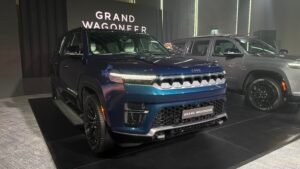
With Jeep, the message from customers was quite clear. They wanted us to make things simpler, more competitive and more straightforward.That is exactly what we are doing with the Grand Wagoneer. We are introducing a simplified lineup with a clear value proposition, making it easier for customers to understand what they are getting.
As for the Grand Cherokee, the current generation was introduced in 2021, followed by its arrival in the Middle East. We felt this was the right moment to refresh the vehicle, improve its infotainment technology and introduce a more efficient powertrain.
Fahed Abu Salah: Why introduce these changes now rather than last year or next year? Is there a particular reason behind the timing?
Yousef Bouhaddioui: We are following our global product plan, and the timing is aligned with that strategy.Next year, we have other priorities on the agenda, particularly when it comes to our core Jeep lineup, including the Wrangler and Gladiator.These are extremely important products for the brand, so we need to make sure that we give each model the attention it deserves.
Fahed Abu Salah: Moving to the Grand Cherokee, would you describe this as a facelift or a more substantial update? What are the biggest differences compared with the outgoing model?
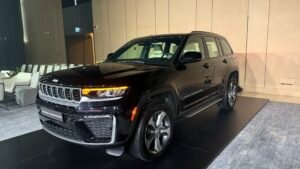
Yousef Bouhaddioui: It is essentially a mid-cycle facelift, but there are some significant improvements.
From a design perspective, we have updated the front end of the vehicle to give it a fresher appearance.Inside, we have focused on the infotainment system, introducing a larger central display and revising the layout of the centre console.However, I would say the biggest change is under the bonnet.We are moving away from the previous 3.6-litre Pentastar V6 engine and introducing a new 2.0-litre turbocharged four-cylinder engine from our group.
Despite having a smaller displacement, the new engine delivers more power and torque while also offering improved fuel efficiency.That is particularly important because customers want performance, but they also want better efficiency and greater driving range. With the new powertrain, we are looking at a driving range of around 850 kilometres on a single tank.
Fahed Abu Salah: This brings me to an interesting point. Stellantis has recently been bringing back V8 engines in some of its American vehicles, yet the Grand Cherokee is moving from a 3.6-litre V6 to a 2.0-litre four-cylinder. How do you think customers in the Middle East will react to that?
Yousef Bouhaddioui: I think it really depends on the vehicle segment and how customers use their cars.When we talk about pickup trucks, the feedback from customers was very clear. They wanted V8 engines, and we listened.With SUVs such as the Grand Cherokee, the situation is different.
Of course, these vehicles remain very capable, but the reality is that many customers use them primarily for everyday driving on the road.In that environment, engine displacement is not necessarily the most important factor.What matters is the performance the engine delivers, particularly its power and torque, alongside fuel efficiency.
If we can offer customers better performance and improved fuel economy from a smaller engine, then we believe that is a very compelling proposition.We understand that the Middle East has a strong connection with larger engines, but we also believe customers will appreciate the improvements once they experience the vehicle.
Fahed Abu Salah: Since we are talking about engines, I have to ask: will we ever see a V8 return to the Grand Cherokee?
Yousef Bouhaddioui: We’ll see.
There are always discussions taking place when it comes to powertrain strategies and future products.
Fahed Abu Salah: So we shouldn’t completely rule it out?
Yousef Bouhaddioui: We’ll see.
Fahed Abu Salah: Looking at the Grand Cherokee and Grand Wagoneer together, how do you see their future in the Middle East? Are you positioning Jeep more directly against established luxury SUV manufacturers?
Yousef Bouhaddioui: The Grand Cherokee and Grand Wagoneer will continue to represent the flagship SUVs within the Jeep lineup.
What these vehicles demonstrate is that Jeep is not exclusively an off-road brand.Of course, off-road capability remains at the heart of our identity, but we are also capable of producing sophisticated, luxurious and technologically advanced SUVs.With the Grand Cherokee and Grand Wagoneer, we want to show customers that Jeep can deliver comfort, technology and refinement alongside the capability the brand is known for.
However, I would not necessarily position us directly within the traditional luxury segment.I think the more appropriate description is upper mainstream.
We want to offer many of the features, technologies and comfort levels customers associate with premium vehicles, but at a much more accessible price point.That is an important part of our strategy.
Fahed Abu Salah: So the idea is to offer a luxury experience without necessarily charging traditional luxury SUV prices?
Yousef Bouhaddioui: Exactly.
We want the vehicles to be competitive and straightforward in terms of both their specifications and pricing.That is part of the reason behind simplifying the Grand Wagoneer lineup.
Customers should be able to clearly understand the value they are getting without having to navigate an unnecessarily complicated range of configurations.
Fahed Abu Salah: Speaking of pricing, what can you tell us about the expected prices of the Grand Wagoneer and Grand Cherokee in the Middle East?
Yousef Bouhaddioui: For the Grand Wagoneer, we are positioning the vehicle competitively within the full-size American SUV segment.
Depending on the market and the trim level, we are looking at prices in the region of $90,000 to $100,000.The exact pricing will be communicated through our local partners and distributors in each country.
For the Grand Cherokee, our objective is slightly different.We want to give customers more without significantly increasing the price.There may be some minor pricing adjustments because the previous model was approaching the end of its lifecycle, but overall, we intend to maintain a similar pricing position.Customers will benefit from improved technology, a more advanced powertrain and additional refinement while keeping the vehicle competitive in its segment.
Fahed Abu Salah: Will that approach apply across the Grand Cherokee lineup, or are there specific versions receiving different equipment and positioning?
Yousef Bouhaddioui: The objective is to maintain a competitive offering across the lineup.
We are also looking at the positioning of individual trims, including the five-seat Limited version, which offers a slightly sportier character and additional equipment.The important thing is to make the range easier to understand and ensure that each version offers a clear proposition to the customer.
A More Focused Strategy for Jeep in the Middle East
What became clear throughout my conversation with Bouhaddioui is that Jeep is approaching its next chapter with a different set of priorities.The brand is not abandoning the characteristics that made it successful in the Middle East. Instead, it is attempting to find a balance between traditional customer expectations and the realities of a changing automotive market.
The decision to replace the Grand Cherokee’s naturally aspirated 3.6-litre V6 with a turbocharged 2.0-litre four-cylinder engine is perhaps the clearest example of this strategy. For some buyers, particularly in a region where engine displacement has historically played an important role in purchasing decisions, the move could initially raise eyebrows.But Jeep’s argument is that customers should ultimately judge the vehicle by what it delivers rather than the size of its engine.
At the same time, the company’s willingness to bring V8 engines back to other American models demonstrates that it recognises the importance of listening to enthusiasts rather than applying a single powertrain strategy across every segment.
The Grand Wagoneer represents another important part of that approach. By simplifying its lineup and targeting a more accessible position within the full-size SUV market, Jeep is hoping to attract customers who want the space, comfort and equipment of an upscale American SUV without necessarily entering the pricing territory of traditional luxury brands.And while Bouhaddioui stopped short of making any commitments about a possible V8-powered Grand Cherokee, his response leaves an interesting question for the future.
For now, Jeep’s message to the Middle East is straightforward: more competitive products, improved technology, greater efficiency and a stronger focus on what customers actually want.Whether that strategy translates into greater success will ultimately depend on how buyers respond to the updated vehicles, particularly the new Grand Cherokee powertrain and the Grand Wagoneer’s revised positioning.
One thing, however, is clear. Jeep is not relying solely on its heritage to compete in the region anymore.