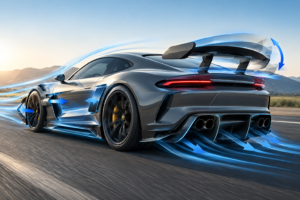



Imagine getting into your car, entering a destination and simply letting the vehicle handle the journey. It sounds like science fiction, but autonomous cars are already capable of handling many driving tasks themselves. Parking assistance can steer a car into a parking space, adaptive cruise control can maintain speed and distance, and advanced systems can help keep a vehicle centred on a highway.
However, there is still a significant difference between driver assistance and a vehicle that can genuinely drive itself. The development of autonomous cars is progressing rapidly, but fully self-driving vehicles are not yet a normal reality for everyday drivers.
From Parking Assist to Highway Driving
The journey towards autonomous driving has happened gradually.
Early parking assistance systems were among the first technologies to take over part of the driving task. Some systems can detect a suitable parking space and control the steering while the driver manages other inputs.
Modern vehicles have taken this much further.
Advanced driver-assistance systems can combine cameras, radar and other sensors to monitor the surrounding environment. Depending on the vehicle and system, they can assist with steering, acceleration, braking, lane positioning and maintaining a safe distance from other vehicles.
On highways, these features can make long-distance driving less tiring. But the driver is still generally expected to remain attentive and ready to take control.
The Difference Between Driver Assistance and Autonomy
One of the biggest misunderstandings surrounding autonomous driving is the difference between assistance and automation.
A driver-assistance system may control certain functions, but that does not necessarily mean the car can handle every situation independently.
The Society of Automotive Engineers (SAE) uses levels of driving automation ranging from Level 0, where there is no sustained driving automation, through Level 5, where the automated driving system can perform the entire driving task under all roadway and environmental conditions. The National Highway Traffic Safety Administration also explains these levels as a way of describing how much of the driving task a system can perform. (nhtsa.gov)
This distinction is important because a vehicle that can steer and maintain speed on a highway is very different from a car that can drive anywhere without human involvement.
What Can Cars Already Do?
Many new vehicles can perform impressive tasks.
Depending on the model, drivers may have access to:
- Adaptive cruise control
- Lane-centering assistance
- Automatic emergency braking
- Blind-spot monitoring
- Traffic-sign recognition
- Automatic parking
- Highway driving assistance
- Lane-change assistance
- Surround-view cameras
These systems can reduce driver workload and improve convenience.
However, they generally operate within specific limitations. Weather, road markings, construction zones, unusual traffic situations and sensor limitations can affect how well the technology performs.
Why Is Fully Autonomous Driving So Difficult?
Driving looks simple to humans because we process enormous amounts of information without consciously thinking about every decision.
A human driver can recognise a temporary road closure, understand that a person standing near a road may suddenly move, interpret gestures from another driver and adjust their behaviour based on context.
Teaching a computer to reliably handle every possible situation is much more complicated.
Road environments are unpredictable. Construction zones change layouts, pedestrians behave unexpectedly, weather conditions can change rapidly and road markings may be unclear.
For autonomous cars to become truly driverless, the technology needs to handle these unusual situations safely and consistently.
Sensors Are Critical
Autonomous driving depends heavily on sensors.
Cameras can identify road markings, vehicles, pedestrians and traffic signs. Radar can help detect objects and estimate their distance and movement. Some systems also use lidar to create detailed three-dimensional information about the environment.
The vehicle’s computer then processes this information to decide what action should be taken.
The challenge is that no sensor is perfect. Cameras can be affected by poor visibility, while other sensors have their own limitations. This is why autonomous-driving developers typically combine multiple technologies rather than relying on a single sensor.
AI Is Changing Autonomous Driving
Artificial intelligence is playing an increasingly important role in vehicle automation.
AI systems can analyse information from multiple sensors and identify patterns that help the vehicle understand its surroundings. Machine-learning techniques can also be used to improve how vehicles recognise objects and respond to different driving situations.
This is one reason the development of autonomous driving has accelerated in recent years.
However, AI does not eliminate the need for extensive testing. A system needs to be reliable not only in normal traffic but also in unusual and potentially dangerous situations.
What About Highway Driving?
Highways are generally easier for automated driving systems than crowded urban environments.
Lane markings are often clearer, traffic generally moves in the same direction and there are fewer pedestrians, cyclists and complex intersections.
As a result, highway driving assistance is one of the areas where drivers are already seeing advanced automation features.
But even on highways, unexpected situations can occur. Road construction, emergency vehicles, debris, aggressive driving and sudden lane changes can challenge automated systems.
That is why drivers still need to understand what their vehicle’s system can and cannot do.
Could Dubai Become a Major Testing Ground?
The UAE has shown strong interest in smart mobility and autonomous transportation.
Dubai, in particular, has announced ambitious plans for autonomous transportation. The emirate’s strategy aims to make 25% of all transportation trips autonomous by 2030. (rta.ae)
This makes the UAE an important market to watch as autonomous mobility develops.
The region’s investment in smart-city infrastructure could also help support connected and automated transportation in the future.
Will We Have Fully Self-Driving Cars Soon?
The answer depends on what we mean by “fully self-driving.”
Vehicles capable of operating autonomously in specific locations or controlled environments are already becoming a reality. Robotaxis and autonomous shuttle services are being tested or deployed in selected markets.
However, a car that can safely drive from any location to any destination without human supervision, regardless of weather, road conditions or traffic complexity, represents a much higher technological challenge.
That is closer to Level 5 automation, and widespread availability remains uncertain.
What Should Car Buyers Expect?
Drivers should look beyond marketing terms when shopping for a vehicle with autonomous-driving features.
Instead of simply asking whether a car is “self-driving,” buyers should find out exactly what the system can do.
Can it maintain the lane? Can it change lanes? Can it stop for traffic? Does it work only on highways? Does the driver need to keep their hands on the steering wheel?
Understanding these limitations is essential.
A sophisticated driver-assistance system can be extremely useful, but it should not be treated as a replacement for an attentive driver unless the system is specifically designed and legally approved to operate without one.
The Road Ahead
The development of autonomous cars is moving from simple assistance towards increasingly sophisticated automation.
Parking systems have evolved into highway-driving assistance, while AI, cameras, radar and other sensors are allowing vehicles to understand increasingly complex environments.
The next major challenge is not simply making cars drive themselves. It is making them reliable enough to deal with the unpredictable situations that humans encounter every day.
Fully autonomous driving may eventually become part of everyday transportation, but the transition will likely happen gradually. For now, the most advanced vehicles are best viewed as highly capable assistants rather than completely independent drivers.
Final Thoughts
From automatic parking to highway assistance, cars are already taking over more parts of the driving task. But there is still a considerable gap between assisting a driver and completely replacing the driver.
The future of autonomous cars will depend on advances in AI, sensors, software, regulation and real-world testing.
For today’s drivers, the smartest approach is to enjoy these technologies while understanding their limitations. The road to truly autonomous driving is well underway—but we are not at the final destination yet.