


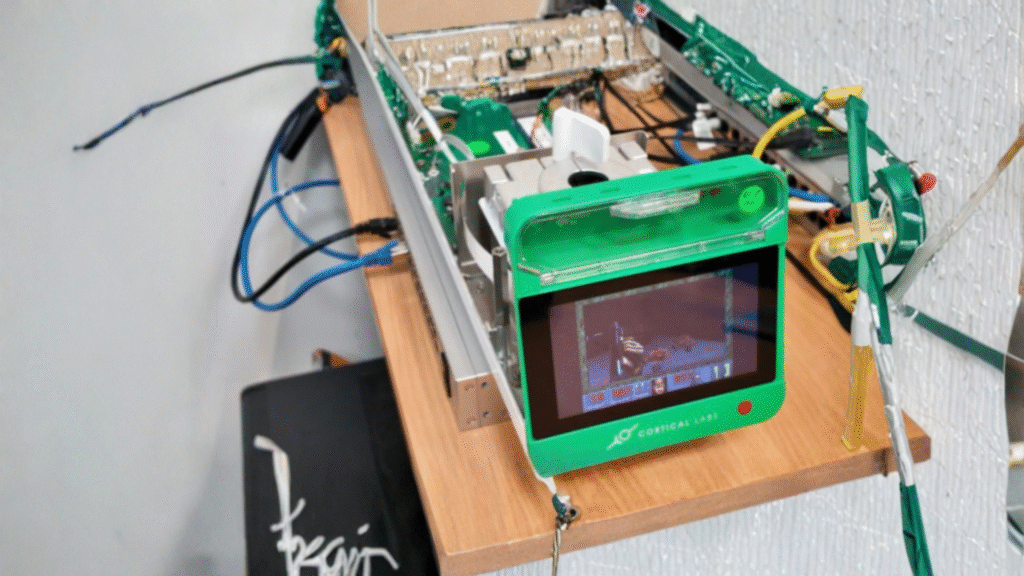

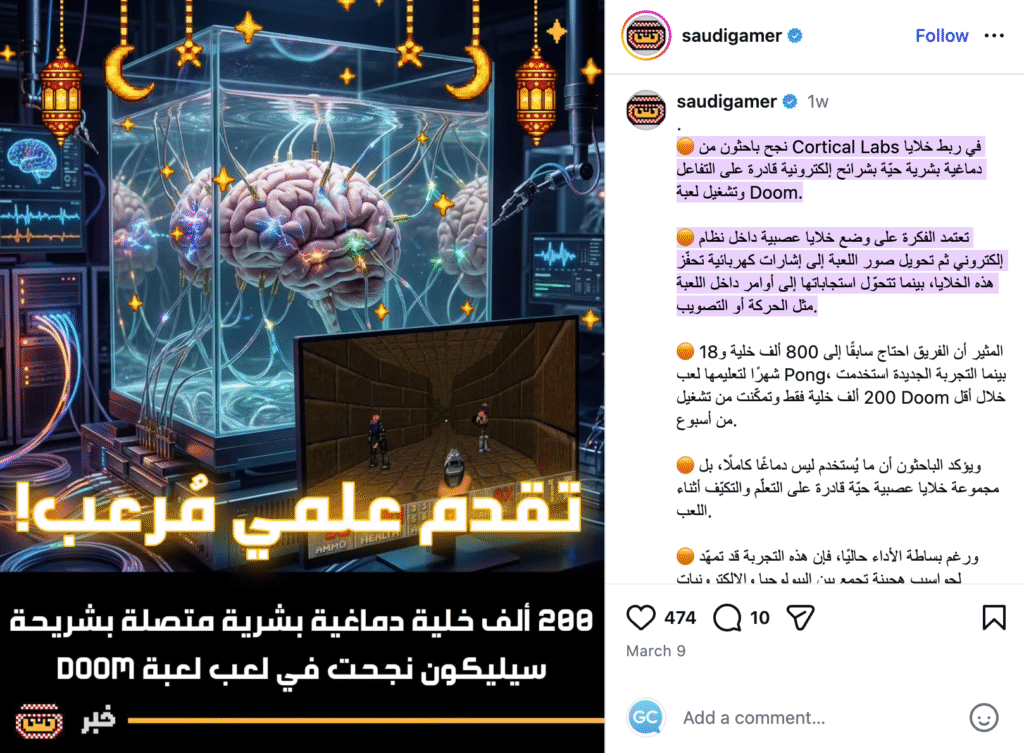
In a breakthrough that feels straight out of science fiction, scientists have developed a brain cell computer capable of playing the iconic game Doom. This experiment goes far beyond gaming. It signals a new era in computing and artificial intelligence.
In fact, the project shows how biology and technology can work together in entirely new ways.
Brain cell computer powered by real human neurons
The system relies on real human brain cells grown in a lab environment. Researchers connect these neurons to electronic circuits, allowing them to send and receive signals.
As a result, the system can interact with digital environments in a way that mimics basic brain functions.
How a brain cell computer plays Doom
To make this possible, researchers translate game elements into electrical signals. These signals represent movement, enemies, and the surrounding environment.
The neurons process this information and respond with outputs that control the game. Although performance remains basic, the achievement itself is groundbreaking.
From Pong to Doom: a major leap forward
Previously, researchers trained similar systems to play simple games like Pong. However, moving to Doom represents a significant step forward.
Unlike Pong, Doom requires spatial awareness, fast reactions, and complex decision-making. Therefore, it serves as a much tougher test for any computing system.
Why this experiment matters
This innovation is not about creating a better gamer. Instead, it focuses on exploring new forms of computing.
In the long term, this technology could:
-
Improve our understanding of the human brain
-
Lead to more efficient artificial intelligence
-
Enable a new generation of biological computers
Moreover, the human brain is far more energy-efficient than traditional computers. This makes it an attractive model for future systems.
Could this shape the future of gaming?
On another level, this development could transform gaming itself. Future systems might respond directly to neural signals.
As a result, interaction between humans and machines could become more immersive than ever before.
In conclusion, the brain cell computer demonstrates that the future of computing is already taking shape. While the technology remains in early stages, its potential could redefine artificial intelligence and human-machine interaction.




Very well presented. Every quote was awesome and thanks for sharing the content. Keep sharing and keep motivating others.
I really like reading through a post that can make men and women think. Also, thank you for allowing me to comment!