

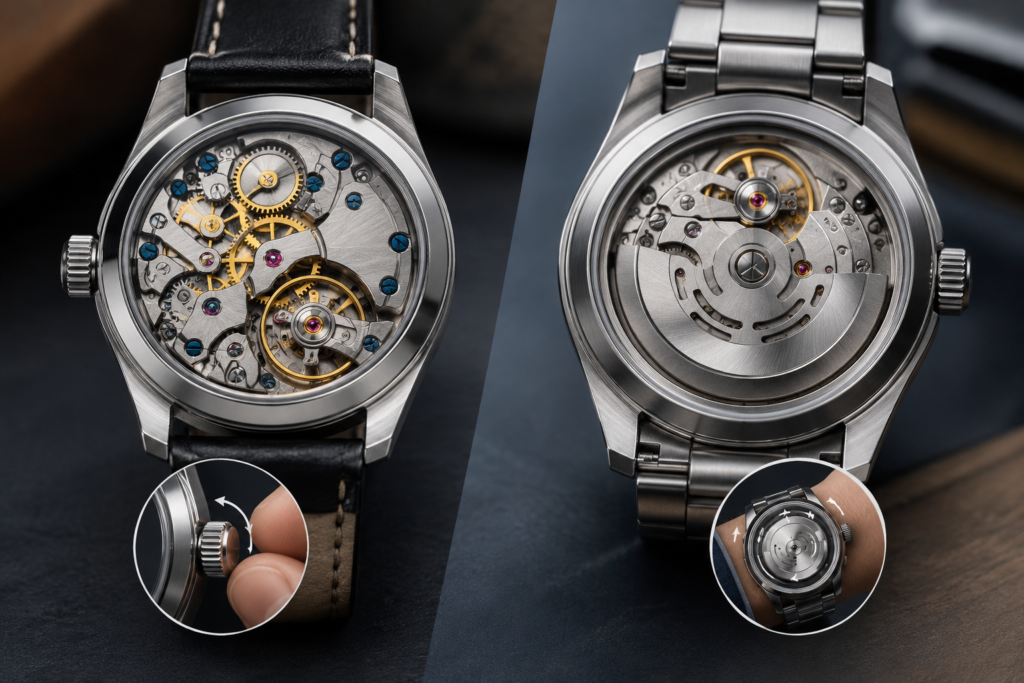

When comparing traditional timepieces, mechanical vs automatic watches is one of the most common questions for buyers interested in classic watchmaking. Both use mechanical movements rather than batteries, but the way they are powered is different. A mechanical watch needs to be wound by hand, while an automatic watch uses the movement of the wearer’s wrist to wind itself.
The two types share much of the same traditional watchmaking philosophy. They use gears, springs and other mechanical components to measure time, making them particularly interesting to people who appreciate engineering and craftsmanship.
What Is a Mechanical Watch?
A mechanical watch is powered by a mainspring that stores energy when it is wound manually. When the crown is turned, the mainspring becomes tighter and gradually releases its stored energy. That energy moves through a series of gears before reaching the escapement and balance wheel, which regulate the movement of the hands.
Because there is no battery, a traditional mechanical watch has to be wound regularly. Depending on the movement and its power reserve, this could mean winding it once a day or after several days.The appeal is partly in the interaction between the owner and the watch. Winding the crown becomes part of the ownership experience, connecting the wearer with the mechanism inside the case.
What Is an Automatic Watch?
An automatic watch uses a mechanical movement but includes a self-winding system. The key component is usually a small weighted rotor that moves as the watch is worn. As the rotor rotates, it transfers energy to the mainspring, gradually winding it.This means an automatic watch can continue running without manual winding as long as it is worn regularly and has enough movement to keep the mainspring charged.
If an automatic watch is left unused for long enough, however, it will eventually stop once its power reserve has been exhausted. The wearer can then restart it by winding it manually or, depending on the movement, simply wearing it again.
Mechanical vs Automatic Watches: The Main Difference
The biggest difference in mechanical vs automatic watches is how the mainspring receives its energy. A manually wound mechanical watch relies on the wearer turning the crown. An automatic watch uses a rotor to convert wrist movement into stored energy.
| Feature | Mechanical Watch | Automatic Watch |
| Power source | Manually wound mainspring | Mainspring wound by wrist movement |
| Battery | No | No |
| Rotor | Usually no | Yes |
| Manual winding | Required | Usually possible |
| Power reserve | Varies by movement | Varies by movement |
| Ownership experience | More hands-on | More convenient for regular wear |
Both are mechanical watches in the broader sense. “Automatic” describes the self-winding mechanism rather than a completely different type of watch movement.
How the Movements Actually Work
Despite their different winding methods, mechanical and automatic watches share many internal components. The mainspring stores energy. Gears transmit that energy through the movement, while the escapement controls how quickly it is released. The balance wheel oscillates back and forth at a specific frequency, helping regulate the movement and keep the hands moving at the correct rate.
In an automatic watch, the rotor adds another layer to this system. Its movement winds the mainspring, reducing the need for the wearer to operate the crown manually. This is why automatic watches can be viewed as a development of traditional mechanical watchmaking rather than a completely separate technology.
Accuracy Is Not Simply About Mechanical vs Automatic
It is easy to assume that one movement type must automatically be more accurate than the other, but the reality is more complicated. Accuracy depends on the specific movement, its construction, adjustment, condition and how it is used. Mechanical watches can experience small variations in timekeeping, and automatic movements can experience them as well.
The quality of the movement and how carefully it has been regulated can therefore be more significant than whether the watch is manually wound or self-winding. Some mechanical movements are designed and tested to meet strict accuracy standards, while others are produced with different priorities such as affordability, durability or finishing.
Power Reserve Matters
Power reserve is another important consideration. A manually wound watch needs to be wound when its stored energy runs out. This can become part of the daily routine for someone who wears the same watch regularly. An automatic watch can continue winding while it is being worn, making it convenient for everyday use. However, if it is removed and left unused for longer than its power reserve, it will stop.
Modern mechanical movements can offer power reserves ranging from roughly a day to several days, depending on the design. For buyers who rotate between several watches, this difference can become noticeable. An automatic watch may need to be reset after sitting unused, just like a manually wound watch.
Which One Offers More Interaction?
A manually wound mechanical watch offers a more direct connection between the wearer and the movement. Winding the crown is a simple action, but it gives the owner a regular opportunity to interact with the watch. For some enthusiasts, this is an important part of the appeal. Automatic watches provide a different experience. The wearer can simply put the watch on and allow normal wrist movement to keep the mechanism wound. Neither approach is inherently better. The preference depends largely on whether the owner values the ritual of winding or the convenience of automatic winding.
Design and Watchmaking
The movement can also influence the design of a watch. Automatic movements require space for the rotor and self-winding mechanism. In many watches, the rotor can be seen through a transparent case back, giving the wearer a view of the movement in operation.
Manually wound movements do not need a rotor, which can allow watchmakers to use the available space differently. This can be particularly appealing in watches where movement finishing and decoration are major parts of the design. Features such as polished bridges, decorated plates and visible gears can turn the movement itself into part of the watch’s visual appeal.
Why Watch Enthusiasts Still Choose Mechanical Movements
Mechanical watches remain popular despite the convenience and accuracy offered by quartz and electronic timepieces. Part of their appeal comes from craftsmanship. A mechanical movement contains numerous precisely manufactured components working together without a battery or electronic motor.
For many enthusiasts, owning such a watch is less about simply telling the time and more about appreciating the engineering, history and traditional skills involved in watchmaking.This is particularly relevant to motorsport enthusiasts, where mechanical watches and racing have shared a long history through timing instruments and racing chronographs.
Mechanical vs Automatic Watches: Which Should You Choose?
The choice ultimately comes down to how you want to interact with the watch. A manually wound mechanical watch may suit someone who enjoys the traditional ritual of winding the movement and wants a direct connection with the mechanism.
An automatic watch may be more convenient for someone who wears the same timepiece frequently and prefers the movement to wind itself through everyday activity. Both offer the experience of traditional mechanical watchmaking. The important difference is simply how the energy reaches the mainspring.
Conclusion
The mechanical vs automatic watches comparison is ultimately about two approaches to powering a traditional mechanical movement. Manual mechanical watches require the wearer to wind the mainspring, while automatic watches use a rotor and wrist movement to wind it. Beyond this difference, both rely on the same basic principles of gears, springs and regulated mechanical motion.
For buyers, the decision is less about which technology is universally superior and more about personal preference. Whether you enjoy winding a watch each morning or prefer the convenience of a self-winding movement, both types offer a direct connection to traditional watchmaking.
For more automotive, motorsport and lifestyle stories, visit the GearsMe homepage. For a deeper look at mechanical watchmaking, you can also explore the Federation of the Swiss Watch Industry’s information on mechanical watches.